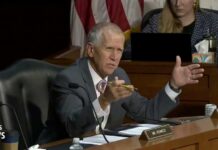

(NationalFreedomPress.com) – House Democrats just launched an impeachment push against Defense Secretary Pete Hegseth over Iran strikes—setting up a fresh war-powers clash that’s unlikely to pass, but designed to brand Trump’s national security team as lawless.
Quick Take
- Rep. Yassamin Ansari and House Democrats filed six articles of impeachment against Defense Secretary Pete Hegseth on April 15, 2026.
- The filing accuses Hegseth of launching or enabling military action against Iran without congressional authorization, plus additional allegations tied to civilian casualties and classified-information mishandling.
- The Pentagon rejected the effort as a partisan “charade,” arguing the department carried out the president’s objectives and achieved “major successes.”
- With Republicans controlling Congress, the impeachment drive is widely viewed as symbolic—but it spotlights a bipartisan pressure point: who decides when America goes to war.
Democrats File Six Impeachment Articles Focused on Iran and Oversight
Rep. Yassamin Ansari (D-Ariz.) and a group of Democratic cosponsors introduced six articles of impeachment against Defense Secretary Pete Hegseth on April 15, 2026. The central claim is that U.S. strikes tied to the Iran conflict amounted to an “unauthorized war” carried out without Congress. The articles also reference allegations of civilian harm, alleged obstruction of Congress, and other conduct Democrats characterize as abuses of power.
The filing arrives in a political environment where Democrats lack the votes to remove a Trump Cabinet official, but can still use impeachment to force messaging votes, drive media coverage, and fuel fundraising. Axios reported the resolution runs about seven pages and includes multiple allegations that go beyond the war-powers dispute. That breadth matters politically: it allows Democrats to frame the case as a pattern of misconduct rather than a single disagreement over policy.
What the Articles Allege—and What Remains Unverified in Public Reporting
Democrats’ accusations include claims of unlawful strikes and references to alleged war crimes tied to civilian casualties, including an incident described as the bombing of a girls’ school in Minab, Iran. The resolution also points to “Signalgate,” described as mishandling sensitive information after The Atlantic’s editor Jeff Goldberg was reportedly included in a Signal chat discussing Yemen strikes. Public reporting summarizes these claims, but does not independently verify casualty details.
That verification gap is a key limitation for readers trying to separate confirmed facts from charged legal language. The research provided here indicates the impeachment articles lean heavily on assertions contained in the resolution itself, while acknowledging uncertainty around the underlying operational details. In practical terms, that means the political fight may move faster than the public record. The result is an information environment where partisans on both sides can cherry-pick the pieces that best fit their narrative.
Pentagon Response: “Charade” vs. Democrats’ “Unlawful Actions” Charge
Pentagon spokesperson Kingsley Wilson dismissed the impeachment effort as a “charade,” arguing it distracts from what the department describes as decisive progress toward President Trump’s objectives. Ansari, by contrast, argues Hegseth “broke his oath” and carried out unlawful military actions. With Republicans controlling both chambers, Democrats’ leverage is limited to hearings, public pressure, and media attention rather than a realistic path to Senate conviction.
Still, the exchange highlights a recurring Washington problem that frustrates voters across the spectrum: major national security controversies often turn into partisan trench warfare, not transparent accountability. Conservatives tend to prioritize decisive defense and credible deterrence, especially when adversaries test American resolve. Many liberals prioritize strict legal constraints and humanitarian safeguards. The public interest is served when Congress clarifies authorization, objectives, and oversight—regardless of party.
The Bigger Issue: War Powers, Congress, and Trust in Government
At the center of the dispute is the War Powers question: when the executive branch uses force, what level of congressional approval is required, and how quickly must Congress be informed? Democrats are using the impeachment tool to argue that the boundary was crossed in Iran. The administration’s defenders counter that military action was necessary and successful. What’s missing—at least in the reporting summarized here—is a shared, trusted set of facts about specific operations.
Politically, this episode feeds a broader 2026 reality: many Americans on the right and left increasingly believe Washington protects itself first. For conservatives, the fear is selective outrage—impeachment energy appears when it can damage Trump, but fades when similar war-powers disputes involve other leaders. For liberals, the fear is executive overreach shielded by party-line votes. Either way, the burden is on Congress to demand clear answers without turning oversight into theater.
Sources:
iran-war-pete-hegseth-congress-impeachment-articles-democrats-reflecting-search-interest-order
house-dems-launch-impeachment-push-hegseth
Copyright 2026, NationalFreedomPress.com