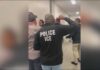


(NationalFreedomPress.com) – A routine ICE arrest in California turned into a gunfight-level flashpoint when agents say a suspected gang member tried to use his car as a weapon—and the video is now fueling a national fight over enforcement, accountability, and trust.
Story Snapshot
- ICE says agents shot a Salvadoran national during a targeted stop in Patterson, California, after he allegedly accelerated his vehicle toward an officer.
- Federal officials describe the man as an 18th Street gang member wanted for questioning in a murder case in El Salvador; his attorney disputes both claims.
- Dashcam video shows agents surrounding the vehicle with guns drawn before the shots, intensifying scrutiny of tactics used in immigration arrests.
- The FBI is investigating the use-of-force incident, and no charges had been announced publicly as of the latest reporting.
What happened during the Patterson ICE stop
ICE agents attempted to arrest Carlos Ivan Mendoza Hernandez, 36, during an early-morning vehicle stop on April 7, 2026, in Patterson, California, near Interstate 5. ICE says the operation targeted Hernandez for questioning in a Salvadoran murder investigation and alleged gang ties. Agents report that moments after they approached, Hernandez accelerated in a way that endangered an officer, prompting defensive gunfire. Hernandez was wounded and hospitalized; no officers or bystanders were reported injured.
Local authorities received a report of an officer-involved shooting around 6:30 a.m., secured the area, and provided medical aid before Hernandez was transported to a hospital. ICE said the FBI was notified to investigate, a standard step in high-profile federal use-of-force incidents. The basic timeline is not heavily disputed across reporting, but the central question—whether Hernandez intentionally tried to run an officer down—remains the key factual issue likely to be tested by video, forensics, and witness interviews.
Conflicting claims: “wanted gang member” vs. “bad information”
ICE leadership publicly framed the incident as a response to a violent suspect using a “weaponized vehicle,” arguing agents acted to protect themselves and the public. Hernandez’s attorney, Patrick Kolasinski, countered that his client is a family man heading to work and said he was never in a gang. The attorney also said Hernandez had been acquitted in El Salvador on the murder accusation, though independent verification of that claim was not established in the reporting provided.
Adding to the dispute is the limited publicly known U.S. criminal history described in the coverage. Reporting cited a recent cracked-windshield citation and little else, which critics point to when questioning whether the intelligence picture was as clear as ICE suggested. Supporters of robust enforcement respond that gang and murder-related concerns may originate overseas and from federal targeting databases, meaning a clean U.S. record does not necessarily settle the public-safety risk question.
What the dashcam video does—and doesn’t—settle
Video from the scene shows agents converging around the vehicle with guns drawn before the shooting, a detail that has driven much of the political reaction. For skeptics, that imagery raises questions about escalation and whether alternative tactics could have reduced the chance of a split-second trigger pull. For enforcement advocates, surrounding a vehicle in a planned stop is consistent with how police manage high-risk suspects, especially when officers believe the target may be dangerous or likely to flee.
Why this matters in the larger immigration enforcement debate
This case sits at the intersection of two realities Americans increasingly argue about at the same time: the government’s duty to enforce immigration law and the public’s demand for transparency when force is used. Conservatives who have watched years of porous-border fallout see the incident as another reminder that officers face real threats during arrests—especially when suspects try to flee. Many liberals and civil-liberties advocates, meanwhile, see the video and competing narratives as evidence the federal system can move fast on force but slow on proving claims.
The FBI investigation will likely determine what evidence can be corroborated: the vehicle’s movement, agent positioning, verbal commands, and whether the suspect’s intent can be reasonably inferred. Until those findings are public, the public debate will continue to run on dueling interpretations—one emphasizing officer safety and the need for firm enforcement, the other emphasizing the risk of misidentification and the danger of labeling someone a gang member before the facts are fully tested.
Sources:
ICE-involved shooting after agency says illegal immigrant gang member tried ram officer
ICE agents shoot man after he allegedly tried to run them over
Copyright 2026, NationalFreedomPress.com