
(NationalFreedomPress.com) – Miami’s Allapattah neighborhood awoke to gunfire, police sirens, and a standoff that exposed the razor-thin line between routine patrol and urban chaos, a day when two officers bled, a gunman barricaded, and a city held its breath to see who would walk away alive.
Story Snapshot
- Two Miami police officers wounded while responding to a car riddled with bullets in Allapattah
- Suspect barricaded himself inside a home, prompting a tense, hours-long standoff
- SWAT and negotiators brought family members to aid in peaceful resolution
- The incident reignites debate about police tactics, community safety, and urban violence
Violence Erupts During Routine Police Response
Gunfire shattered the early morning calm in Allapattah on October 9, 2025, as Miami police responded to a chilling call: a vehicle found “riddled with bullets.” Officers, trained to expect the unpredictable, found themselves in the crosshairs. Within moments, two were shot, one in the knee, another in the ankle, rendering the scene both a crime investigation and a rescue operation. Their injuries, though serious, were not life-threatening. The suspect vanished into a nearby house, setting the stage for a classic Miami standoff.
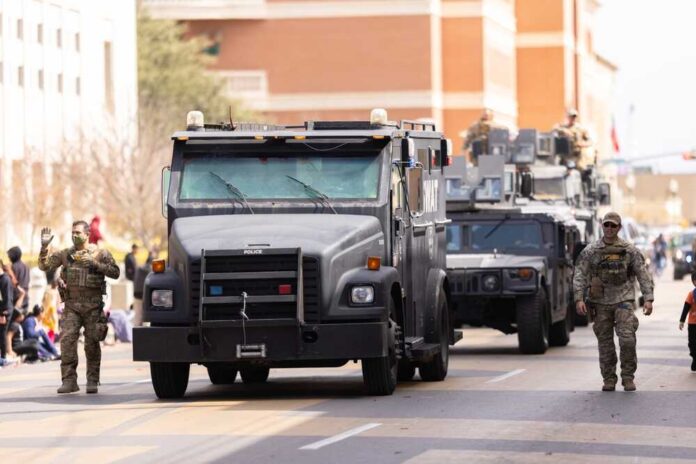
Within minutes, SWAT teams and tactical units cordoned off a four-block radius, transforming 10th Avenue from 14th to 18th Street into an urban fortress. The suspect, identity still unreleased, fortified himself inside, forcing negotiators to balance the urgency of officer safety with the unpredictability of a desperate gunman. As news helicopters hovered overhead, local residents peered from behind curtains, trapped by police lines and fear. This was no isolated event; it echoed a disturbing pattern in Miami’s high-crime districts, where routine calls can spiral into headline-grabbing standoffs in seconds.
Negotiation, Escalation, and the Human Factor
Miami police commanders quickly pivoted from force to finesse, deploying negotiators and calling in the suspect’s family to help de-escalate a tense situation. The standoff dragged into the afternoon, punctuated by shouted pleas and the tense silence of waiting. Family members’ involvement signaled a calculated hope: that personal bonds could succeed where tactics might fail. For the officers, now stable at Jackson Memorial Hospital, the ordeal was a reminder of the occupational hazards that are anything but routine. For the suspect, barricaded and outnumbered, the calculus narrowed to surrender or escalation.
Neighborhood life ground to a halt. Businesses shuttered, parents anxiously kept children indoors, and city leaders braced for public scrutiny no matter the outcome. The use of tactical units, while necessary, always stirs debate, does it protect or further alienate a community already wary of police presence? For Miami, these questions are perennial, the answers ever-evolving with each flashpoint. As negotiators worked, the city watched and waited, caught between empathy for wounded officers and concern for the cycle of violence playing out on its streets.
The Broader Impact: Policy, Protocol, and Public Trust
The Allapattah standoff is more than a local headline; it is a microcosm of the challenges facing American urban policing. Officers face increasing risks from heavily armed suspects and unpredictable scenarios, fueling calls for better training and equipment. At the same time, every deployment of SWAT or tactical units is scrutinized for its impact on civil liberties and community trust. Miami’s history of barricade situations, often resolved through negotiation, reflects a broader shift toward de-escalation, but the margin for error remains slim.
Community advocates demand transparency and restraint, while police unions and conservative voices emphasize the need for robust tactics in the face of escalating violence. The city’s leaders, pressed by both sides, must navigate the politics of public safety—a task made no easier when every incident is livestreamed, tweeted, and dissected in real time. In the short term, Allapattah bears the brunt: disrupted routines, shuttered businesses, and a lingering sense of vulnerability. Long term, incidents like this drive policy reviews and, inevitably, debates over the soul of modern policing.
Expert Analysis: The Lessons, and Limits, of Urban Policing
Law enforcement experts point to the Allapattah standoff as an object lesson in the complexity of urban policing. Negotiation and patience, they argue, are essential tools, especially in densely populated neighborhoods where the risk to bystanders is high. Tactical experts highlight the importance of coordination, training, and measured response. Criminologists see repeating cycles of violence and call for deeper community engagement. As the suspect’s identity and motives remain unclear, mental health professionals may be drawn in to consult on negotiation strategies and post-incident support.
For Miami, the story is both familiar and profoundly unsettling. The tension between force and restraint, safety and civil liberty, will not be resolved by a single standoff. But each incident sharpens the questions: How do we protect those who protect us? How do we keep neighborhoods safe without fueling mistrust? And when the next call comes in, a car riddled with bullets, officers down, will the city’s response have evolved, or will history repeat? Miami’s answer, for now, is to watch, to wait, and to hope for resolution without regret.
Copyright 2025, nationalfreedompress.com