
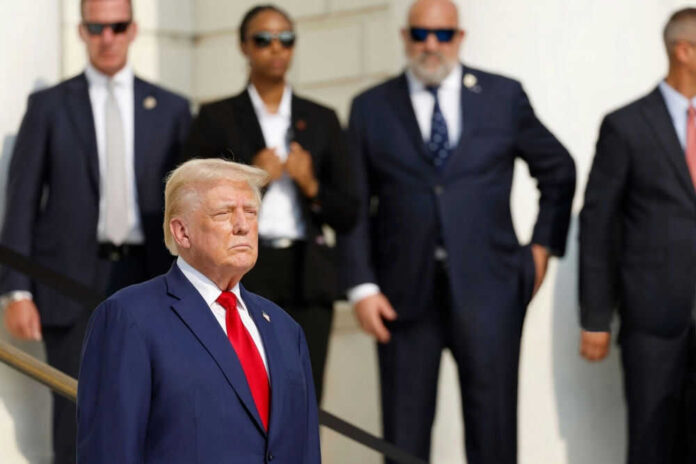
(NationalFreedomPress.com) – History unfolded at Windsor Castle as President Trump became the first U.S. leader ever welcomed for a second state visit, yet outside those gilded gates, protests and projected images threatened to overshadow royal pageantry with reminders of unresolved scandals.
Story Snapshot
- Trump’s unprecedented second U.K. state visit signals a unique, personal rapport with the British monarchy.
- Protests and public displays referencing the Epstein scandal run parallel to formal ceremonies.
- Diplomatic ambitions and controversy collide, highlighting deep social and political divisions.
- Both supporters and critics see the visit as a turning point in U.S.-U.K. relations and public discourse.
Royal Protocol Meets Political Reality at Windsor Castle
September 16, 2025, Stansted Airport, President Donald Trump and First Lady Melania Trump step onto British soil, greeted not only by the stately procession of embassy officials but also by a sense of history. Never before has a U.S. president received a second state invitation to the United Kingdom. The following morning, Windsor Castle rises in regal welcome as King Charles III and Queen Camilla host the Trumps, a ceremonial salute echoing across the ancient grounds. The royal embrace signals more than tradition; it’s a nod to Trump’s enduring, if controversial, relationship with the House of Windsor, and the rare continuity of diplomatic rituals in turbulent times.
Inside Windsor, the mood is all velvet and crystal, punctuated by a special exhibition from the Royal Collection, a gesture underscoring the monarchy’s desire to honor its American guest. Yet, outside those storied walls, the capital simmers. Protesters gather in the thousands, brandishing placards and demanding accountability, their chants swirling beneath the grandeur. The shadow looming largest: Trump’s past associations with Jeffrey Epstein. On the castle’s facade, projected images merge political theater with public outcry, a jarring reminder that no amount of ceremony can fully shield the event from controversy.
Unprecedented Diplomacy, and Unavoidable Protests
The September 17 state banquet, attended by dignitaries and broadcast worldwide, is both spectacle and strategy. For King Charles III, the visit is a deliberate act of diplomacy, reinforcing historic ties while extending personal respect to an American president whose political career has defied precedent. Trump, in turn, lavishes praise on the royal family, highlighting what he calls their “unbreakable bond” with the United States. These displays of civility are carefully choreographed, but outside, protest groups seize the spotlight. Their message is blunt: diplomatic tradition cannot whitewash lingering questions about character and judgment.
September 18 brings a shift from ceremony to substance. Trump’s meeting with Prime Minister Keir Starmer at Chequers is billed as a chance to “reset” transatlantic cooperation on trade, security, and climate. Meanwhile, Melania Trump joins Queen Camilla for a private tour, a gesture of soft diplomacy aimed at reinforcing ties between the two nations’ first families. Yet, as negotiations unfold behind closed doors, media coverage remains transfixed by the protests. Images of Trump and Epstein, projected onto Windsor’s ancient stone, go viral, cementing the sense that this visit, while historic, is also haunted by unresolved baggage.
Divided Perceptions: Diplomacy, Scandal, and the Power of Pageantry
The second state visit is more than a matter of protocol; it’s a test of public opinion and political resilience. For Trump’s supporters, the royal welcome is validation, a sign that his brand of leadership commands respect beyond America’s borders. For critics, the pageantry is window dressing, designed to distract from uncomfortable truths. Protests, amplified by social media and unflinching news coverage, remind the world that power and privilege are never immune from scrutiny. The juxtaposition of red carpets and protest banners encapsulates a broader crisis of trust, not just in leaders but in the institutions meant to hold them accountable.
Expert commentary underscores the stakes. Historians point to the visit’s uniqueness: no modern president has been so publicly embraced by the British monarchy, nor so dogged by controversy. Analysts warn that, while diplomatic ties may be strengthened, the polarization on display could have lasting implications. Economic cooperation and shared security interests are bolstered, but the social fabric, strained by protest and counter-protest, remains fragile. For many, the enduring image of Trump’s second state visit is not the white-gloved banquet but the flickering images on castle walls, a reminder that history is written as much by dissent as by ceremony.
Copyright 2025, nationalfreedompress.com