
A resurfaced claim says Jocelyn Benson was an FBI informant, but the public record confirms undercover work for a private group, not a federal source relationship.
Story Highlights
- Benson described going undercover for the Southern Poverty Law Center after college.
- Records show she later served on the group’s board from 2014 to 2018.
- Michigan legislators released emails showing post-2019 contact between Benson and the group.
- No public evidence confirms Benson was an FBI informant.
What the resurfaced claim says and what is verified
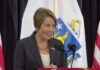
Political outlets are circulating a video that claims Michigan Democrat Jocelyn Benson admitted she worked undercover for the Southern Poverty Law Center and acted as an informant for the Federal Bureau of Investigation. Reporting and Benson’s past writing back up the undercover work for the private group. She posed as a freelance journalist to meet with extremist leaders and gather information after college. The allegations about an FBI informant role are not supported by public records identified so far.
Bridge Michigan reviewed Benson’s background and found that she wrote about her undercover work and that a campaign official described her as a volunteer researcher after college. That work included attending meetings and rallies while collecting material for the group’s Intelligence Report. These details confirm she did undercover research for a private organization. They do not identify an FBI file, a handler, a payment trail, or a confidential-source designation that would show a federal informant tie.
Board service, later emails, and the separate federal case
Bridge Michigan reported that Benson served on the Southern Poverty Law Center board from 2014 through 2018, years that overlap with later federal indictments involving the group’s alleged use of paid informants in extremist groups. The indictments did not name Benson as a defendant, and available reporting does not show she approved or knew about any informant payments. Benson has said her board role was mostly ceremonial and that she was not aware of such payments.
Michigan House Republicans later publicized emails from the Michigan Department of State that, they say, show Benson remained in contact with the group after she took office. One email thread described her participation in a May 2019 event with other secretaries of state. These communications point to continued institutional contact. They do not by themselves show undercover activity or any Federal Bureau of Investigation coordination.
What remains disputed and what readers should watch
The current dispute turns on a common error in political fights: mixing three separate roles into one claim. The record supports two roles for Benson. She did undercover research for a private group after college, and she later served on its board. A third role, acting as a Federal Bureau of Investigation informant, would require separate proof. That would look like an identifiable source number, a handler, or a payment record. That evidence has not surfaced in public materials cited by either side.
Some critics argue that her board role overlapped with years now under federal scrutiny. That timing is real, and it raises fair questions about governance and oversight. But overlap alone does not prove knowledge or approval. Without board minutes, budgets, or emails tying her to specific payments, the claim stays unproven. The Southern Poverty Law Center has defended its prior use of confidential informants as part of its intelligence program and denies the criminal allegations.
Why this matters beyond one candidate
Many voters on the right and the left share a concern that elites hide the ball while insiders protect each other. This case touches that nerve. People see undercover work, secret payments, and a federal case, and they worry about power without sunlight. That is why clear records matter. If Benson held a deeper operational role, official files could show it. If not, the public deserves a clean separation between confirmed facts and campaign noise.
Racism has NO PLACE in our state or our country.
Jocelyn Benson faces multiple racial discrimination lawsuits from her own staff.
These allegations point to a disturbing PATTERN, and she owes Michigan ANSWERS.https://t.co/eWAhw1GbN3 pic.twitter.com/Hi9fNZo0Yy
— John James (@JohnJamesMI) October 9, 2026
Here is the bottom line for readers. Established facts show undercover work for a private watchdog and later board service. Emails confirm ongoing contact after she took office. None of that, on its own, proves an informant relationship with the Federal Bureau of Investigation. If new documents appear, they should be specific and verifiable. Until then, treat the roles as distinct, and demand records, not headlines, to judge the claims.
Sources:
thegatewaypundit.com, deadlinedetroit.com, gophouse.org
© nationalfreedompress.com 2026. All rights reserved.